Las Vegas Ham Radio Repeaters & Frequencies
The Sin City Repeater Group operates and supports a multi-site amateur radio network serving Las Vegas, Henderson, Southern Nevada and affiliated regions. Find VHF, UHF and 900 MHz frequencies, PL tones, P25 NACs, AllStar nodes, TGIF talkgroups, EchoLink access, programming help and visitor information here.
Las Vegas Ham Radio Frequencies to Program First
If you are visiting Las Vegas, recently earned your amateur radio license, or simply want the fastest way into the Sin City Repeater Group network, start here. These repeaters provide useful coverage across different parts of the Las Vegas Valley and Southern Nevada. The complete directory immediately below includes the rest of the Sin City Repeater Group and affiliated repeater system.
Input: 443.325 MHz
TX CTCSS: 107.2 Hz
P25 NAC: 702
AllStar: 42630
Input: 444.700 MHz
TX CTCSS: 107.2 Hz
P25 NAC: 702
AllStar: 42631
Input: 440.375 MHz
TX CTCSS: 107.2 Hz
AllStar: 42632
Input: 443.875 MHz
TX CTCSS: 114.8 Hz
P25 NAC: 293
AllStar: 29342
Input: 144.790 MHz
TX CTCSS: 100.0 Hz
RX: CSQ
AllStar: 56474
Las Vegas Ham Radio Repeater Frequencies, PL Tones, P25 NACs & AllStar Nodes
This is the primary Sin City Repeater Group directory for Las Vegas ham radio repeater frequencies and public programming data. It covers Sin City Repeater Group-operated, member-sponsored and affiliated systems in Las Vegas, Henderson, Southern Nevada and connected regions. Search by frequency, site, callsign, mode or AllStar node. Click any published AllStar node number to open its AllStarLink statistics page. The status dot reports AllStarLink network status, not RF-site health.
| Output | Input | Call | Location | Band | Mode | TX Access | RX Tone | P25 NAC | AllStar | Hardware / Notes |
|---|---|---|---|---|---|---|---|---|---|---|
| 145.390 | 144.790 | W7IVK | Downtown Henderson, NV | 2m | FM AllStar | 100.0 Hz | CSQ | – |
56474
Checking
|
Motorola XPR-8400 |
| 147.210 | 147.810 | N4NJJ | Centennial Hills, Las Vegas, NV | 2m | FM P25 AllStar | 107.2 Hz | 107.2 Hz | 702 |
43750
Checking
|
Motorola Quantar |
| 420.850 | 425.850 | N4NJJ | Arden Peak / Black Mountain, Henderson, NV | 70cm | FM P25 | 107.2 Hz | 107.2 Hz | 702 | – | Motorola Quantar |
| 445.375 | 440.375 | N4NJJ | Centennial Hills, Las Vegas, NV | 70cm | FM AllStar | 107.2 Hz | 107.2 Hz | – |
42632
Checking
|
Motorola Quantar |
| 445.400 | 440.400 | N4NJJ | Lone Mountain / Majestic Park, Las Vegas, NV | 70cm | FM AllStar | Contact Sin City Repeater Group | Contact Sin City Repeater Group | – |
413941
Checking
|
Motorola XPR-8400 |
| 445.800 | 440.800 | K7GIO | Henderson, NV | 70cm | FM P25 | 107.2 Hz | 107.2 Hz | 293 | – | Owner-maintained system |
| 445.975 | 440.975 | N4NJJ | Centennial Hills, Las Vegas, NV | 70cm | FM P25 AllStar | 107.2 Hz | 107.2 Hz | 702 |
42632
Checking
|
Motorola XPR-8300 |
| 446.825 | 441.825 | N4NJJ | Southwest Las Vegas, NV | 70cm | FM AllStar | 107.2 Hz | 107.2 Hz | – |
41394
Checking
|
Motorola XPR-8400 |
| 446.875 | 441.875 | KI7VLP | Sunset Park, Las Vegas, NV | 70cm | FM AllStar | 114.8 Hz | CSQ | – |
506601
Checking
|
Motorola MaxTrac system |
| 446.875 | 441.875 | N7RMK | Fernley, NV | 70cm | FM | 114.8 Hz | 114.8 Hz | – | – | Owner-maintained repeater |
| 447.975 | 442.975 | W7IVK | Blue Diamond, NV | 70cm | FM | Redacted | Redacted | – | Standalone | Motorola GR-1225 / 52 remote-base function |
| 448.325 | 443.325 | N4NJJ | Angel Peak, NV | 70cm | FM P25 AllStar | 107.2 Hz | 107.2 Hz | 702 |
42630
Checking
|
Motorola Quantar |
| 448.875 | 443.875 | K7RSW | Downtown Henderson, NV | 70cm | FM P25 AllStar | 114.8 Hz | 114.8 Hz | 293 |
29342
Checking
|
Motorola Quantar |
| 449.700 | 444.700 | N4NJJ | Low Potosi, NV | 70cm | FM P25 AllStar | 107.2 Hz | 107.2 Hz | 702 |
42631
Checking
|
Motorola Quantar |
| 927.1125 | 902.1125 | W7IVK | Arden Peak / Black Mountain, Henderson, NV | 33cm | FM 900 MHz | 100.0 Hz | 100.0 Hz | – | – | Owner-maintained 900 MHz system |
| 927.5625 | 902.5625 | N4NJJ | Centennial Hills, Las Vegas, NV | 33cm | FM P25 900 MHz AllStar | 107.2 Hz | 107.2 Hz | 702 |
42628
Checking
|
Motorola Quantar |
| 448.375 | 443.375 | N4NJJ | Kingman, AZ | 70cm | FM AllStar | 107.2 Hz | 107.2 Hz | – |
47366
Checking
|
Motorola GR-1225 |
| 449.680 | 444.680 | W6GLW | Barstow, CA | 70cm | FM AllStar | 91.5 Hz | 91.5 Hz | – |
592284
Checking
|
Motorola XPR-8400 |
| 447.775 | 442.775 | AD0TP | Colorado Springs, CO | 70cm | FM AllStar | 156.7 Hz | 156.7 Hz | – |
58493
Checking
|
Affiliate / owner-maintained |
| 447.675 | 442.675 | KA0WUC | Lamar, CO | 70cm | FM | Managed | Contact Sin City Repeater Group | – | – | Affiliate / owner-maintained |
| 442.675 | 447.675 | N4NJJ | Williamsville / Buffalo, NY | 70cm | FM | 107.2 Hz | 107.2 Hz | – | – | Motorola Quantar |
AllStar status is third-party network status. Green means AllStarLink reports the node Active. Red means the service reports the node inactive. Gray means status could not be retrieved. None of these indicators proves that the local RF transmitter, antenna system or site power is healthy.
Inside the W7RPT Las Vegas Repeater Network
The network is more than a list of frequencies. Sin City Repeater Group members install, maintain and support amateur radio equipment at sites across the Las Vegas Valley and Southern Nevada. These three locations include some of the systems most useful to local operators and visitors.
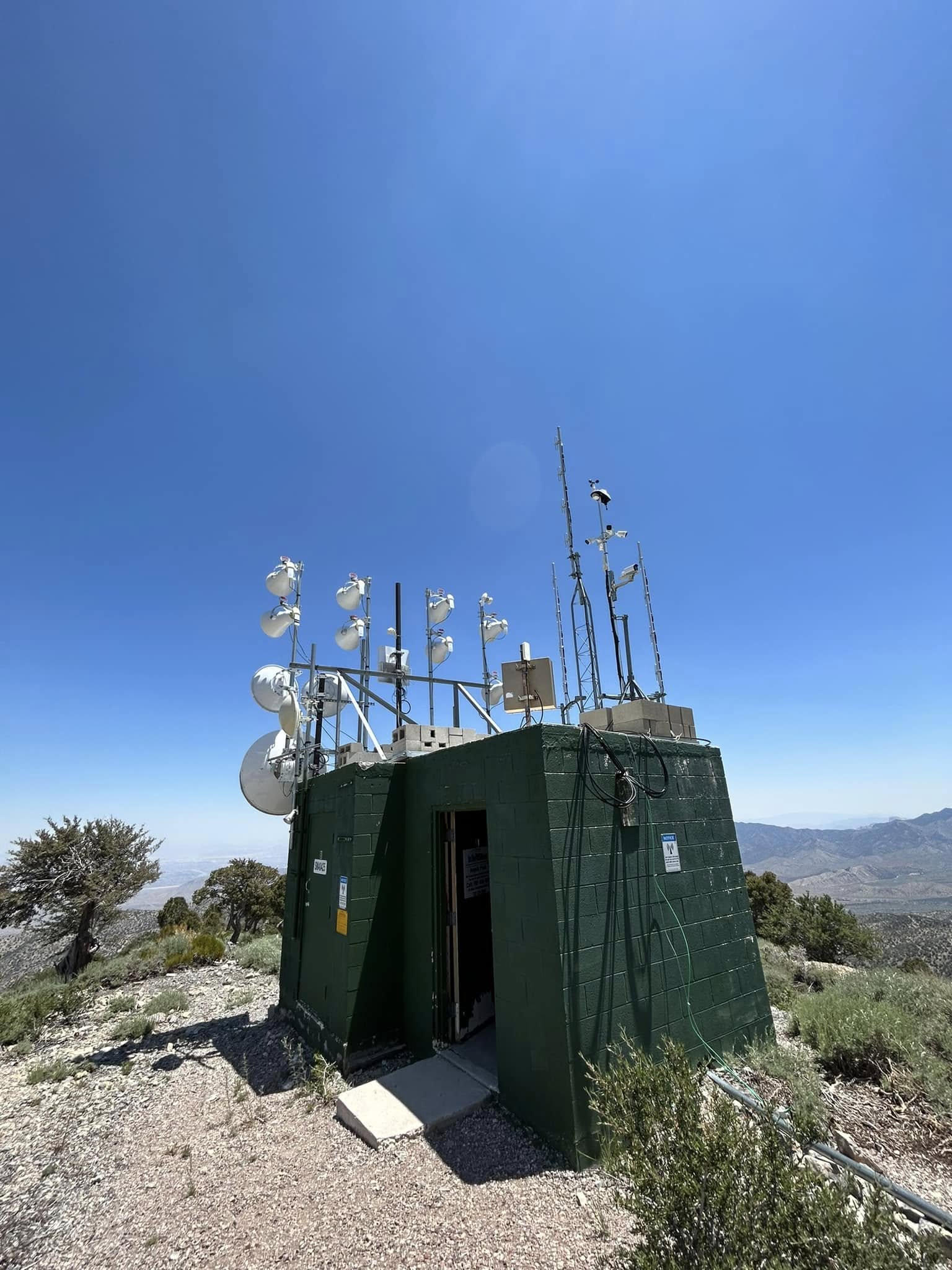
Angel Peak N4NJJ
One of the network’s primary Southern Nevada mountain systems. Program 448.325 MHz receive, 443.325 MHz transmit and 107.2 Hz CTCSS for analog FM. P25 uses NAC 702, and the published AllStar node is 42630.
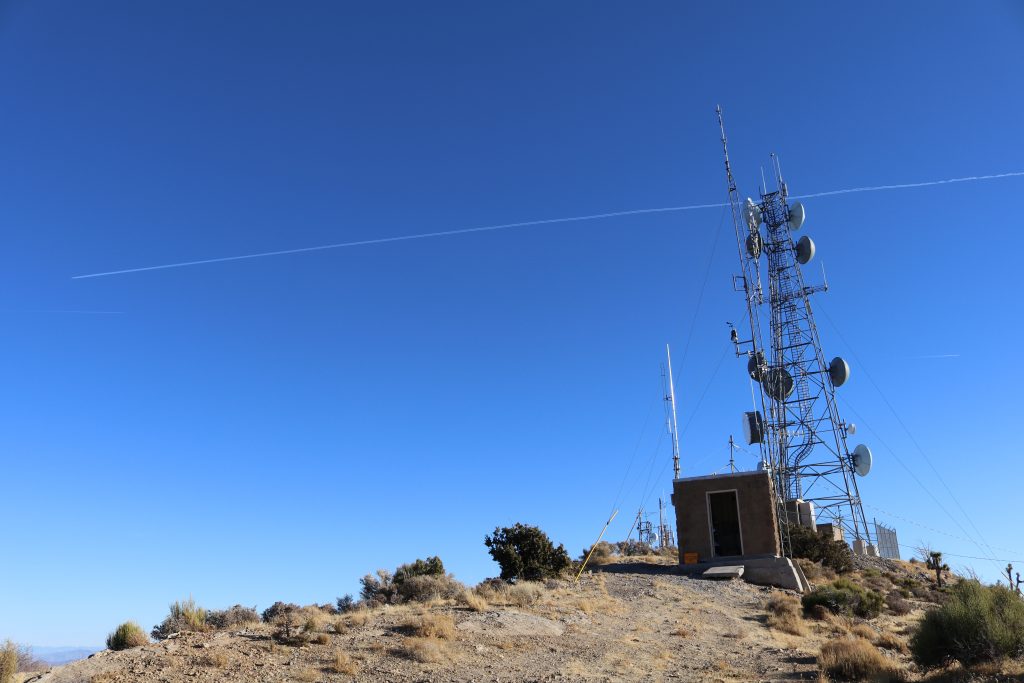
Low Potosi N4NJJ
The 449.700 MHz system uses 444.700 MHz input and 107.2 Hz CTCSS for analog FM. It also supports conventional P25 with NAC 702 and uses published AllStar node 42631.
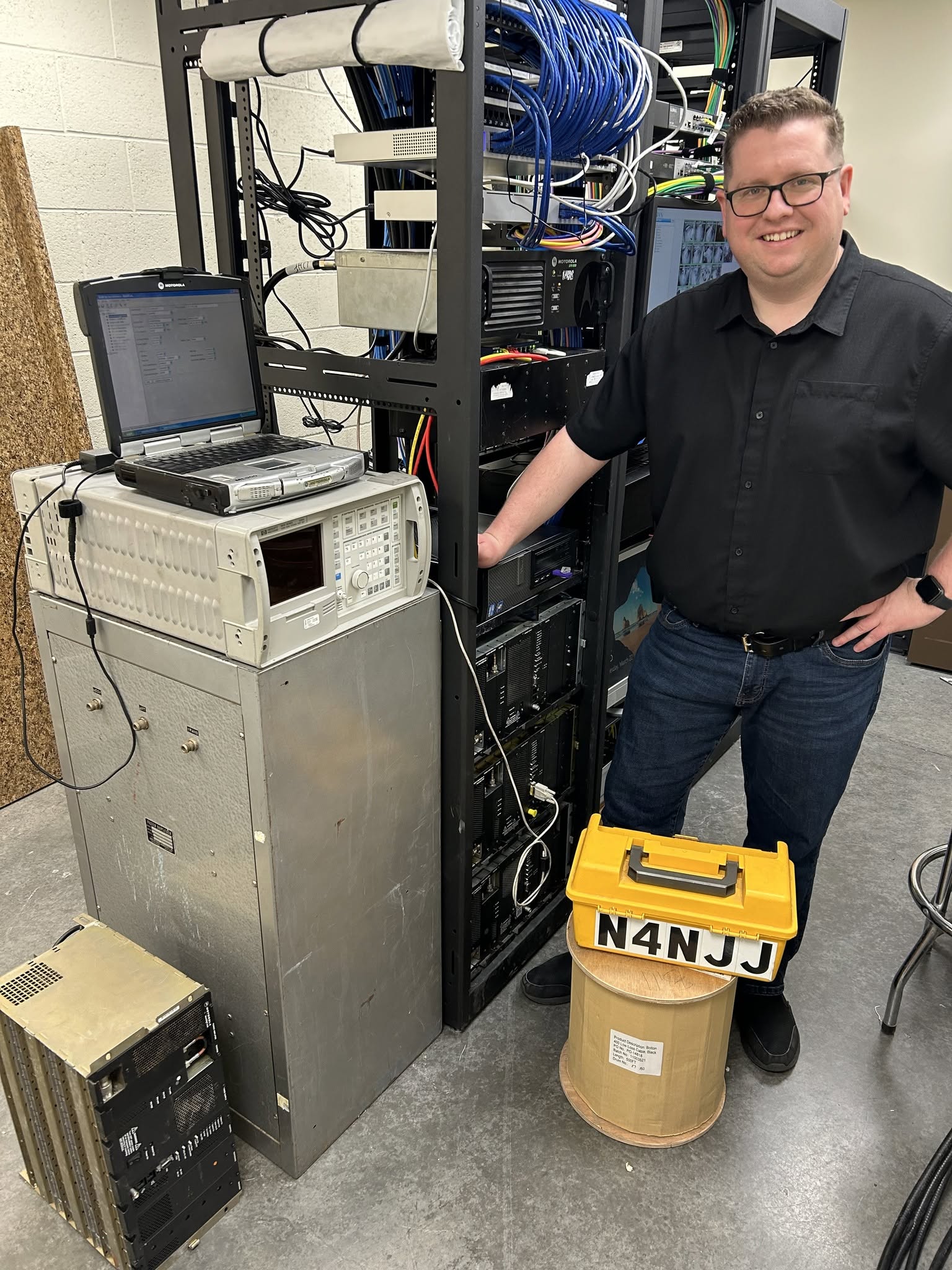
Centennial Hills Repeater Location
Founding President Bill N4NJJ at the Centennial Hills location. The site supports multiple W7RPT systems, including 445.375 MHz, along with additional VHF, UHF and 900 MHz infrastructure listed in the directory above.
Sin City Repeater Group Repeater Use & Conversation Guidelines
You do not need a technical question, emergency, club announcement or net script to key a Sin City Repeater Group repeater. Most of the time, the point is simply to talk. We want a system where operators can get to know one another, laugh, compare notes, learn something, argue about the best pizza in town and occasionally even talk about radios.
Broad Conversation Is Welcome
Sin City Repeater Group is intentionally permissive about normal adult conversation. Politics and religion are not automatically forbidden topics, but we ask operators not to let either subject dominate the system or turn a friendly conversation into a grievance session. Current events are fine. Strong opinions are fine. Being disagreeable for sport is not the culture we are building.
If another operator politely asks to move on from a subject, the expectation is simple: move on. There is no need to demand to know who complained, argue about a supposed right to continue, or turn the request itself into the next twenty minutes of airtime.
A Few Boundaries Matter
Hate speech, sexually explicit conversation, deliberate harassment and conduct intended to bully, belittle, humiliate or repeatedly bait another operator are not welcome on Sin City Repeater Group systems.
If your idea of a QSO is making somebody else the target, this is the wrong network. You may be asked to stop, change the subject, disconnect, or take your operating somewhere else.
W7RPT AllStarLink Hubs: 42230, 422314 & 47366
Sin City Repeater Group maintains three primary AllStarLink destinations. They are not interchangeable labels; each hub has a different operating purpose. If you are new to the network, start on Hub 42230. Operators using QSO One can connect through AllStarLink Web Transceiver access without owning a personal AllStar node.
42230 • Primary National Feed
The normal starting point for W7RPT. Use Hub 42230 for general monitoring, calling another station, everyday conversations, public nets, check-ins and routine linked-network activity. This is also the hub associated with our warm relationship with the Buffalo Amateur Radio Repeater Association in Western New York.
View AllStar status for 42230422314 • The Soapbox
The Soapbox is the secondary destination for extended ragchews, technical discussions, audio testing, experimentation and longer conversations. If a QSO on 42230 is settling in for the long haul, moving to 422314 leaves the primary feed available for general traffic.
View AllStar status for 42231447366 • High Desert Feed
Hub 47366 is the regional High Desert destination for related repeater and linked-node activity outside the primary Las Vegas feed. The number 47366 is also used for the W7RPT P25 talkgroup on the MMDVM P25 network, but the AllStar hub and the P25 talkgroup are separate network destinations.
View AllStar status for 47366P25 Talkgroup 47366 & TGIF DMR Talkgroups 1952 / 42230
The W7RPT operating environment uses conventional P25 on RF, the MMDVM P25 network and two TGIF DMR talkgroups. A PL tone, P25 NAC, AllStar node and digital talkgroup are different settings. The repeated numbers are intentional, but they do not make the underlying networks the same thing.
Conventional P25 on RF
Several W7RPT and affiliated repeaters support conventional APCO P25 directly over RF. Multiple W7RPT systems use NAC 702; selected affiliated systems use NAC 293. A NAC is a P25 channel-access value. It is not a talkgroup and it is not an analog PL tone.
MMDVM P25 • TG 47366
Networked P25 activity uses the MMDVM P25 network with P25 Talkgroup 47366 as the W7RPT destination. This is separate from conventional RF NAC programming. The number also matches AllStar Hub 47366, but those are two different network services.
TGIF DMR • TG 1952
Talkgroup 1952 is one of the two TGIF DMR destinations used by the Sin City Repeater Group community. Select TG 1952 in a properly configured TGIF-capable radio, hotspot or supported application when you want to reach the group through TGIF DMR.
TGIF DMR • TG 42230
Talkgroup 42230 is the second W7RPT TGIF DMR destination. The number intentionally matches the familiar primary AllStar hub number, but TGIF 42230 is a DMR talkgroup while AllStar 42230 is an AllStarLink hub. Program or select them according to the network you are actually using.
Connect to W7RPT Online: QSO One, EchoLink & AllStar
You do not have to be within RF range of Las Vegas to say hello. Sin City Repeater Group welcomes licensed amateurs connecting through supported internet-linked amateur radio systems. QSO One is especially useful because it brings AllStarLink, EchoLink and TGIF DMR into one application.
QSO One
QSO One is a free amateur radio app supporting AllStarLink, Web Transceiver mode, EchoLink and TGIF DMR among other networks.
Open the W7RPT QSO One Setup GuideQSO One official website
TGIF DMR
W7RPT uses two TGIF DMR destinations: Talkgroup 1952 and Talkgroup 42230. Connect through QSO One or another properly configured TGIF client, select the desired talkgroup and give the group a call.
AllStar Web Transceiver
QSO One supports AllStar Web Transceiver mode. Search for the Sin City Repeater Group node or hub you want to reach and connect where Web Transceiver access is enabled.
EchoLink
Sin City Repeater Group-connected EchoLink access is available through N4NJJ-R, EchoLink node 881948. QSO One and the official EchoLink clients can both be used.
Visit EchoLinkSin City Repeater Group Hub 42230 & Buffalo Amateur Radio Repeater Association
Hub 42230 is also part of a relationship that matters to Sin City Repeater Group well beyond the technology. Sin City Repeater Group has developed a warm working relationship with the Buffalo Amateur Radio Repeater Association, Inc. (BARRA) in Western New York. BARRA has served the Buffalo and Niagara Frontier amateur radio community since 1967, and its repeaters are operated as open systems for licensed amateurs.
Several Sin City Repeater Group members are in the Buffalo and Niagara Falls area, and Sin City Repeater Group Founding President Bill N4NJJ is originally from Buffalo. The connection has grown into an ongoing exchange of friendship, technical knowledge, repeater experience and on-air conversation between operators more than 2,000 miles apart.
AllStar makes that relationship easy to hear, but the network link is not the point. The people are. If you hear Western New York operators on 42230, say hello. If you are in Buffalo and hear Las Vegas coming through, do the same.
How to Program Las Vegas Sin City Repeater Group Repeaters into a Baofeng UV-5R
These instructions are written for the classic Baofeng UV-5R family menu system with memory channels 000 through 127. Baofeng has sold many radios under similar model names, and firmware behavior can vary. If the keys or menu numbers on your radio do not match these instructions, stop and identify the exact model before continuing. A programming cable and CHIRP are usually faster, but every step below can be completed from the radio’s front panel on a compatible UV-5R.
Before programming any of the three repeaters
- Press VFO/MR until the radio is in Frequency (VFO) mode, not Memory mode.
- Press A/B so the upper A display is selected. Classic UV-5R memory programming must be performed from the upper display.
- Make sure the A display is on the UHF band. On UV-5R versions with a BAND key, use it if necessary before entering the frequency.
- Turn Dual Watch off: MENU 7 MENU select OFF MENU EXIT.
- Leave receive CTCSS and receive DCS OFF for this beginner configuration. They are not required to access the repeater and leaving receive tone squelch off simplifies troubleshooting.
- Choose an unused memory channel. If you are unsure whether it is empty, delete it first: MENU 28 MENU choose the channel MENU EXIT. Use the same channel number for both saves below.
Angel Peak | N4NJJ | 448.325 MHz | 107.2 Hz
448.325 MHz
443.325 MHz
-5.000 MHz
107.2 Hz
Program the memory
- Complete the preparation steps above and choose an empty memory channel. We will call it CH.
- Enter the repeater output frequency on the upper A VFO: 4 4 8 3 2 5. Confirm the display reads 448.325.
- Set transmit CTCSS: MENU 13 MENU select 107.2 Hz MENU EXIT.
- Store the receive side in the empty channel: MENU 27 MENU select CH MENU EXIT.
- Now enter the repeater input frequency directly: 4 4 3 3 2 5. Confirm the display reads 443.325. Do not change the 107.2 Hz transmit tone.
- Store the transmit side into the same CH: MENU 27 MENU select the same CH MENU EXIT.
- Press VFO/MR to return to Memory mode and select CH. If the display is set to show frequency, it should show 448.325 while receiving.
- Listen before transmitting. For a test, identify normally, for example: “W1ABC testing through Angel Peak.” Do not repeatedly key the repeater without identifying.
Low Potosi / Sin City 700 | N4NJJ | 449.700 MHz | 107.2 Hz
449.700 MHz
444.700 MHz
-5.000 MHz
107.2 Hz
- Complete the preparation steps above and choose an empty memory channel CH.
- Enter 4 4 9 7 0 0. Confirm 449.700.
- Set Menu 13 T-CTCS to 107.2 Hz: MENU 13 MENU 107.2 MENU EXIT.
- Save 449.700 as the receive side: MENU 27 MENU CH MENU EXIT.
- Enter 4 4 4 7 0 0. Confirm 444.700.
- Save 444.700 as the transmit side into the same CH using Menu 27 again.
- Return to Memory mode with VFO/MR, select CH, listen first, then make an identified test call.
Centennial Hills 375 | N4NJJ | 445.375 MHz | 107.2 Hz
445.375 MHz
440.375 MHz
-5.000 MHz
107.2 Hz
- Complete the preparation steps above and choose an empty memory channel CH.
- Enter 4 4 5 3 7 5. Confirm 445.375.
- Set Menu 13 T-CTCS to 107.2 Hz: MENU 13 MENU 107.2 MENU EXIT.
- Save 445.375 as the receive side: MENU 27 MENU CH MENU EXIT.
- Enter 4 4 0 3 7 5. Confirm 440.375.
- Save 440.375 as the transmit side into the same CH using Menu 27 again.
- Return to Memory mode, select CH, listen first and make an identified test call.
Quick Reference
| Sin City Repeater Group Repeater | Receive / Output | Transmit / Input | TX CTCSS | UV-5R Capability |
|---|---|---|---|---|
| Angel Peak | 448.325 MHz | 443.325 MHz | 107.2 Hz | Analog FM only; P25 requires a P25-capable radio |
| Low Potosi / Sin City 700 | 449.700 MHz | 444.700 MHz | 107.2 Hz | Analog FM only; P25 requires a P25-capable radio |
| Centennial Hills 375 | 445.375 MHz | 440.375 MHz | 107.2 Hz | Analog FM |
UV-5R programming section reviewed October 7, 2026. Menu behavior is based on the classic UV-5R family memory architecture. Radio variants and firmware revisions can differ; identify your exact model if the controls do not match.
Ham Radio Repeater Programming: What the Fields Mean
Output Frequency
The frequency your radio receives. This is normally the number used to identify the repeater.
Input Frequency
The frequency your radio transmits to the repeater when you press PTT.
CTCSS / PL
A continuous subaudible analog tone used to access a repeater or control receiver squelch.
DCS / DPL
A digital coded squelch method used by some analog systems. It is not interchangeable with CTCSS.
P25 NAC
A Network Access Code used in conventional APCO P25. It is not an analog PL tone.
AllStar Node
A network identifier for an AllStarLink-connected node, repeater or hub. Click published nodes in the table for status.
Talkgroup
A digital network destination used by systems such as DMR and networked P25.
CSQ
Carrier squelch. No receive tone is required to open the receiver.
Standalone
A machine that operates independently rather than being continuously tied to the Sin City Repeater Group linked network.
Las Vegas Ham Radio Repeater FAQ
Can visiting hams use Sin City Repeater Group repeaters?
Yes. Licensed amateur radio operators are welcome on Sin City Repeater Group machines configured for public guest operation. Join conversations, participate in public nets and introduce yourself.
What can we talk about on Sin City Repeater Group repeaters?
Almost any normal conversational topic is welcome, including food, sports, current events, radios, computers, gaming, cars, mechanical projects, gardening, off-roading, travel and everyday life. Politics and religion are not automatically prohibited, but we ask operators to keep them civil and avoid letting them dominate the system.
What conversation is not welcome?
Hate speech, sexually explicit conversation, harassment, bullying, repeated personal attacks and behavior intended to humiliate or bait another operator are not welcome.
What if somebody asks to change the subject?
Change the subject. A polite request to move on should not become an argument over who made the request or whether someone has a right to continue using private repeater infrastructure for that topic.
Can I connect to Sin City Repeater Group without being in Las Vegas?
Yes. Depending on the network and access method, operators can reach Sin City Repeater Group through AllStarLink, QSO One, EchoLink and TGIF DMR.
What are the W7RPT TGIF DMR talkgroups?
Sin City Repeater Group uses TGIF DMR Talkgroup 1952 and Talkgroup 42230. They are separate DMR talkgroups. TGIF 42230 should not be confused with AllStar Hub 42230, even though the number is the same.
What is the W7RPT P25 talkgroup?
Sin City Repeater Group uses P25 Talkgroup 47366 through the MMDVM P25 network. Conventional RF NAC values such as 702 are separate settings. AllStar Hub 47366 is also a separate network destination.
What is the Sin City Repeater Group EchoLink node?
N4NJJ-R, EchoLink node 881948, provides EchoLink access associated with the Sin City Repeater Group environment.
What do the colored AllStar dots mean?
Green means AllStarLink reports the node Active. Red means it does not currently report the node as active. Gray means the status request could not be completed. This is network status, not proof of RF transmitter health.
Can a Baofeng UV-5R use the P25 side of a Sin City Repeater Group repeater?
No. A standard UV-5R is an analog FM radio. It can use the analog side of compatible Sin City Repeater Group repeaters but does not transmit APCO P25.
Why are some repeater access settings not published?
A small number of systems use managed access parameters for technical, site or operational reasons. Those values are intentionally excluded from the website source. Contact Sin City Repeater Group for current programming when appropriate.
Do I need to be a Sin City Repeater Group member to use the repeaters?
Membership is not required for ordinary guest use of systems made available for public amateur operation. Individual machines may still have managed access requirements.
Have a Radio or an App? Give Us a Shout.
Whether you live in Las Vegas, are driving through Southern Nevada, are sitting in Buffalo, or are connecting through QSO One from somewhere else entirely, the invitation is the same: listen, key up, identify and say hello. These systems are here for people to use. If Sin City Repeater Group infrastructure, education and operating activities are useful to you, donations help support repeater sites, equipment, networking, maintenance and the nonprofit’s amateur radio mission.